
Pondering Pentecost
Pondering Pentecost
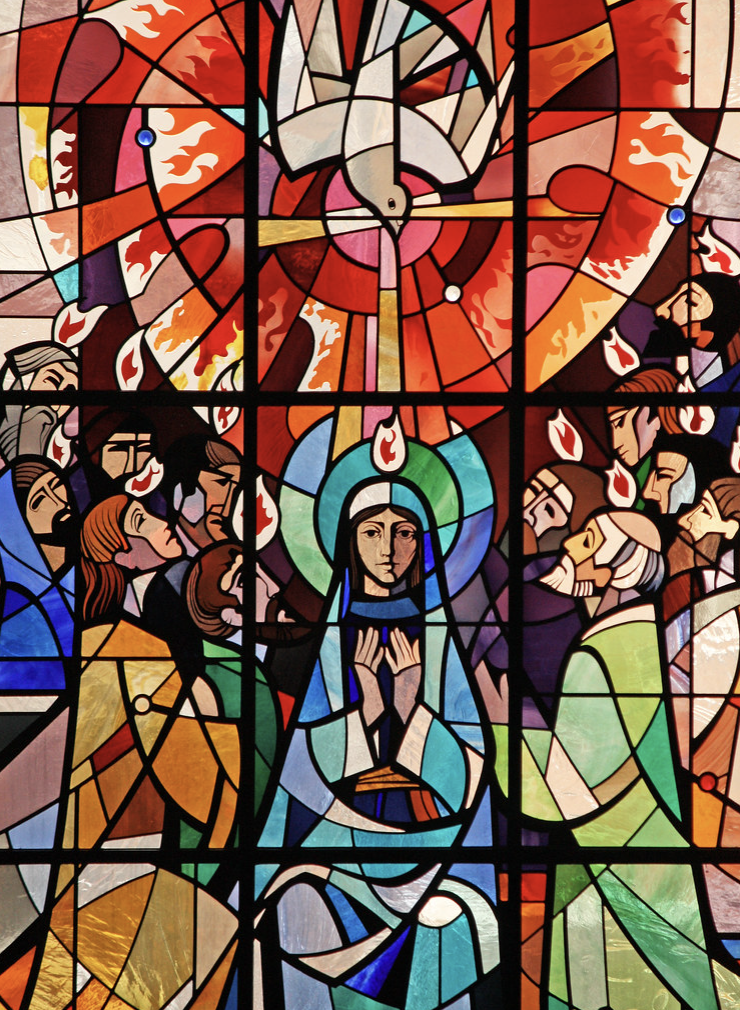
At the time of preparing this reflection it was Pentecost – the birthday of the church. And it got me pondering about being present with others, and those flames that get sparked in our lives sometimes.
I enjoy sharing the Pentecost story when I run my Sacramental Classes for a group of children aged 8 or 9. We think about those friends of Jesus, and his mother Mary, gathered in the upper room. We wonder how they might have felt.
The doors and windows might have been shut tight – but still the wind came into the room. That surprises them!
Then flames…special flames above their heads! I have little wooden peg men displayed to show the children – and we light flames (birthday candles!) above their heads. The children always go a bit quiet at this part. They seem to understand that something special happened in that moment. And we remember that Mary was there too – ever present.
Frank and I recently ran a day of prayer and reflection for a group from Whangarei who wished to explore more about the Marist spirituality. Pentecost pondering popped it’s head up there too. Frank shared this insight:
“The Church no longer exercises the powerful influence on society it once had. Today it is lay people, not clerics, who are in positions of greatest influence and they are more in touch with their culture. The attitudes of more people are changed over the back fence, in pubs, offices, canteens, and coffee-bars than in churches.”
— Frank McKay, The Marist Laity (Maristica 4, 1991)
An upstairs room
There is a sentence in the Acts of the Apostles that, if you blink, you will miss. After Jesus has ascended, the disciples gather in an upper room in Jerusalem. Luke writes:
“All these were constantly devoting themselves to prayer, together with certain women, including Mary the mother of Jesus, as well as his brothers.” ACTS 1 : 1 4
She is simply there, hidden in the midst, supporting. Mary’s presence, “simply there, hidden in the midst, supporting” is an important point to note.
The Marist Vision: A Model of the Early Church
How can we be “simply there” for others in our lives? This is a special call for Marists and something that the founder of the Marist’s, (Fr JC Colin) often pondered too. My friend Kevin Head SM explained this nicely in the Marist Messenger some years back:
“The image of Mary that Fr Colin most often used to encourage Marists was that of Mary at Pentecost, in the midst of the new-born Church. On one occasion he said Mary ‘did more than the apostles for the new-born Church; she is the Queen of the apostles, but she did it without any stir, she did it above all by her prayers’ (A Founder Speaks, 190 # 2.)
Mary works harmoniously with the other members of the community, doing so without making herself the centre of attention, or claiming privilege or superior status. This representation of Mary gave the Marist founder a model for the congregation he led.
“ Mary is in the centre in the early Church, not saying much, listening carefully to everyone, not claiming to be the only one who can resolve issues, nor arguing from authority. Like any mother, Mary desires that her family will live and flourish in love of one another.” ~ Mary at Pentecost and in the new-born Church, written by Kevin Head, published in the Marist Messenger in April 2016
In lots of ways, Mary was hidden in the scene (although some beautiful artwork puts her in the middle of the Pentecost story) – but the point was she was there, present and supportive.
The Flames of Pentecost: From Head to Heart
And what about those flames?
We know that the flames in the Pentecost story represent the Holy Spirit. Those flames sat above the heads of those who knew and loved Jesus. But they didn’t just alter something in their heads – they altered something in their hearts too.
Albert Schweitzer (humanitarian and winner of the Nobel Peace prize) spoke about the “flame within us” He shared these words:
"At times our own light goes out and is rekindled by a spark from another person. Each of us has cause to think with deep gratitude of those who have lighted the flame within us." - Albert Schweitzer winner of the Nobel Peace Prize in 1952
The Power of the Laity: Faith Beyond the Pulpit
As lay people trying to follow Mary’s example, we are in the perfect position to ‘rekindle sparks’ in those around us. Maybe it is a friend coming to you with a problem or a relative going through a hard time.
Frank McKay, writing about Marist laity, wrote about something similar:
“The Church no longer exercises the powerful influence on society it once had. Today it is lay people, not clerics, who are in positions of greatest influence and they are more in touch with their culture. The attitudes of more people are changed over the back fence, in pubs, offices, canteens, and coffee-bars than in churches.”
— Frank McKay, The Marist Laity (Maristica 4, 1991)
The places of real influence in the world today — the back fence, the office, the school gate, the coffee shop, the family kitchen, the group chat — are not the pulpit. They are your places. And those places ask of you exactly what we see in Mary: to be present, prayerful, attentive.
I have no doubt, that long after Pentecost when things got hard again, that Mary would have been a support for the disciples, encouraging them and “rekindling the spark” in their hearts.
It all makes for some prayerful Pentecost pondering if you ask me!

"At times our own light goes out and is rekindled by a spark from another person. Each of us has cause to think with deep gratitude of those who have lighted the flame within us." - Albert Schweitzer winner of the Nobel Peace Prize in 1952

REFLECTION QUESTION
The Pentecost symbols of wind and flame are special ones. How do you notice these symbols in your life?
Read the quote above by Franciois Marc SM. What do you think he means by “go out?” and the phrase “unties tongues?”
“Let them learn...to find in the
presence of Mary at Pentecost...the
secret of their own presence in the
church and the world of today...This
was Mary’s way; this is Mary’s work.”
~Marist Constitutions n.228
